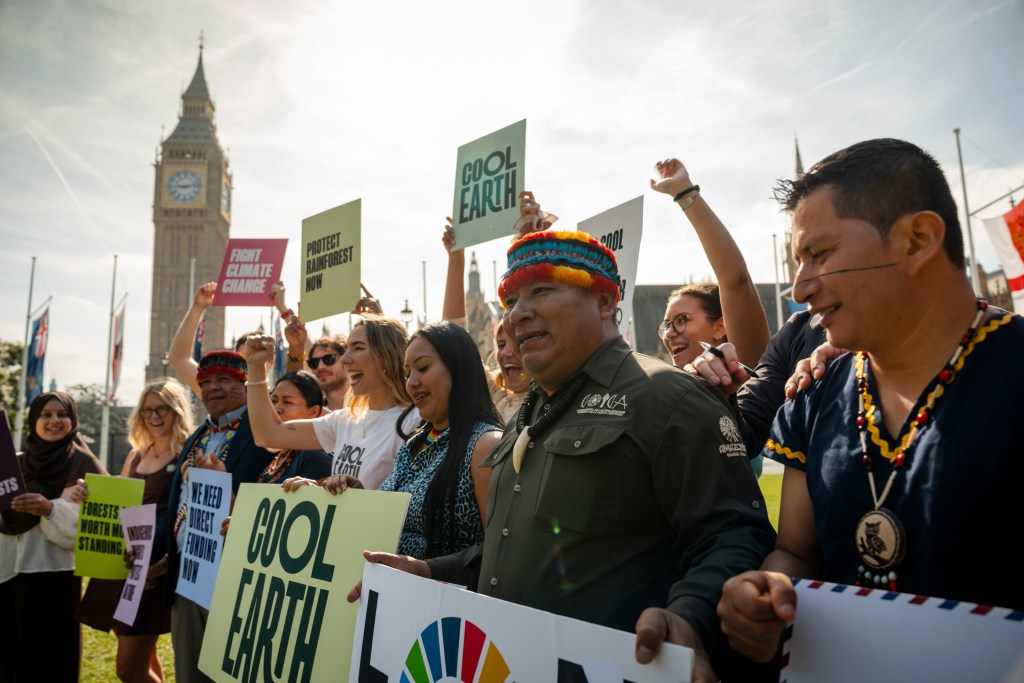
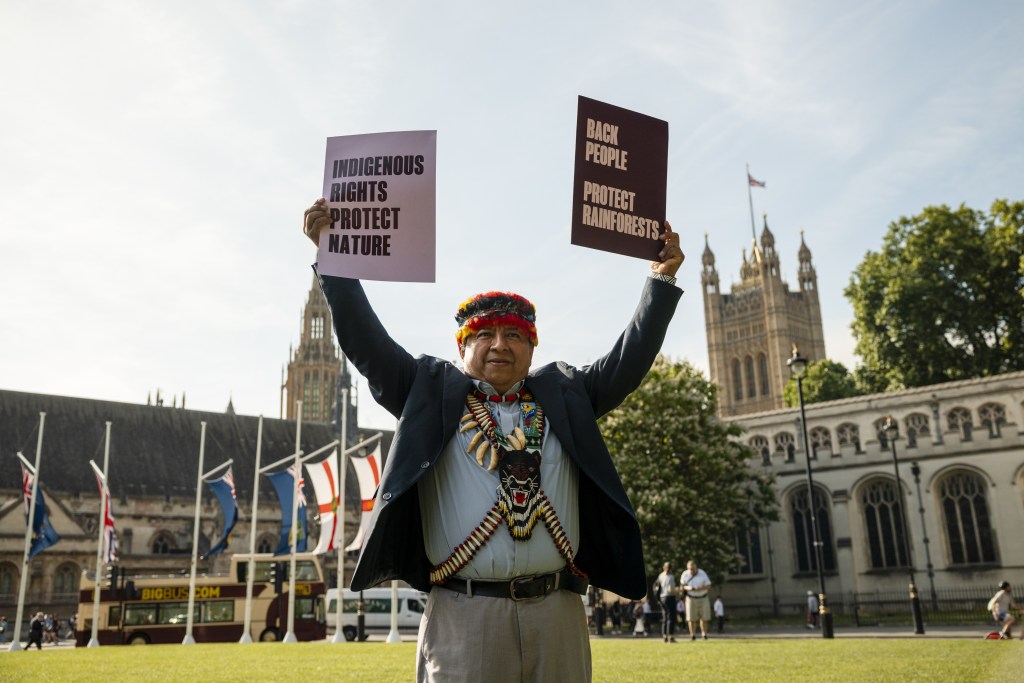
Indigenous leaders kicked off London Climate Action week with a protest on Parliament Square calling for more direct financing for Indigenous peoples. Representatives of Indigenous territories in Ecuador, Brazil, Costa Rica, Indonesia, Cameroon, the Democratic Republic of the Congo, supported by members of the NGO Forest Coalition, called on the UK Government to demonstrate its commitment to forest protection and human rights with an ambitious increase in the share of funds the UK channels directly to Indigenous and community-led organisations.
Juan Carlos Jintiach Arcos, Executive Secretary of the Global Alliance of Territorial Communities (GATC) and a member of the Shuar people of the Ecuadorian Amazon explained that the people protect their lands from threats from illegal loggers, miners, cattle ranchers and land grabbers – often at great personal risk – and they want to be recognised as partners by the UK government in their joint fight to protect the world’s ecosystems and biodiversity from collapse.
This is a cause that unites everyone. UK citizens are affected by nature and biodiversity loss, and food security in the UK is linked to food production in the tropics. Weather systems are disrupted by large-scale deforestation and emissions from land use change contribute to global warming.
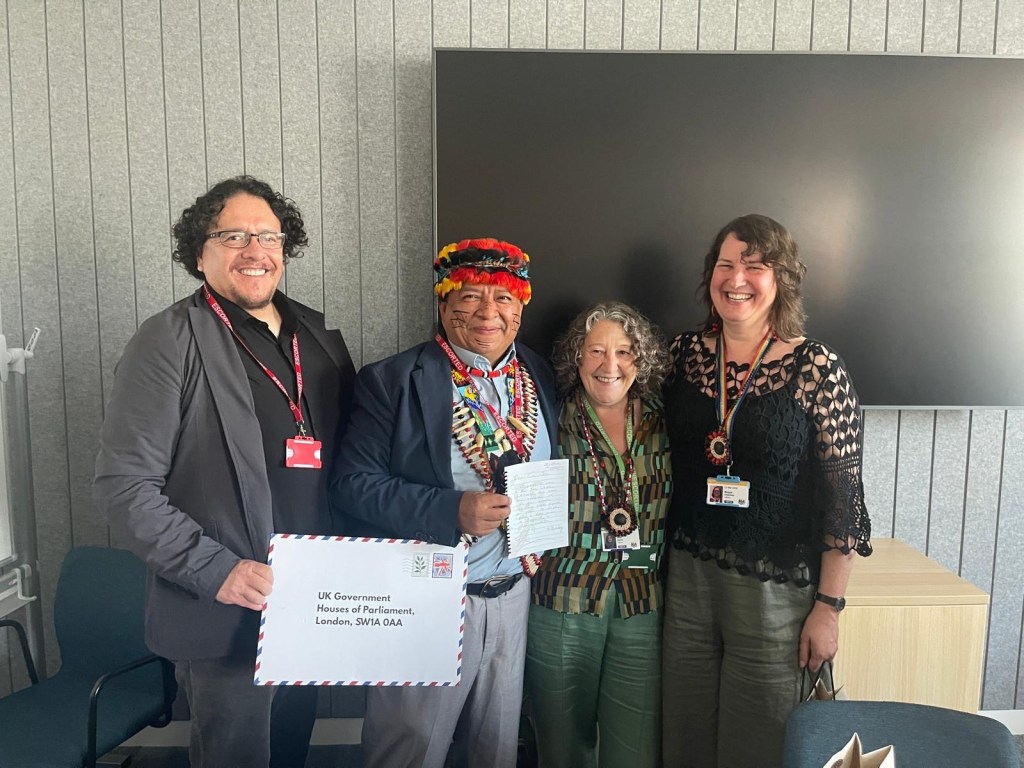
The Indigenous leaders presented a letter to the Foreign Secretary articulating their demands for the UK Government to strengthen its implementation of the Forest and Land Tenure Pledge made at COP30.
Ruth Davis, the UK Special Representative for Nature, met the GATC delegation and received the letter on behalf of the UK government. She told them, “You are the most important partners that we have in implementing the work that we do in protecting tropical forests.”
Specifically, the letter asked the UK government to:
- increase the proportion of UK forest and nature finance delivered directly to Indigenous Peoples and Local Communities
- publicly disclose how much funding currently reaches Indigenous Peoples and Local Community-led organisations and commit to annual reporting
- establish regular and transparent dialogue with Indigenous Peoples leaders to remove barriers that prevent funding from reaching frontline forest stewards.
Juan Carlos Jintiach Arcos explained that the territories managed by Indigenous peoples affiliated with GATC cover 958 million hectares, and every day people work and fight to protect their land, but they face many challenges. They want to strengthen their relationship with the UK government and work in partnership for forest protection.
Marisol Garcia Apagueño, the women’s representative of GATC said that it is important to work with territorial funds such as Shandia Platform because they are being applied on the ground with a gender perspective. The Shandia Platform facilitates direct funding for Indigenous Peoples and Local Communities through regional and national funding mechanisms.
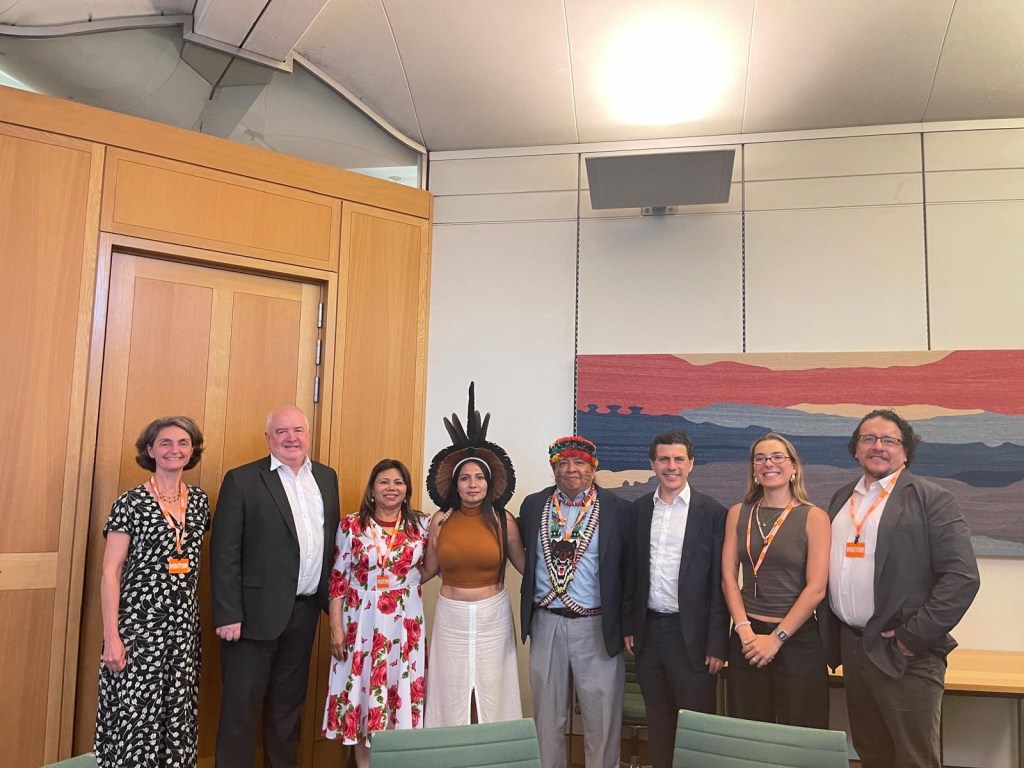
The GATC delegation also met Pippa Heylings MP, Co-chair of the All-Party Parliamentary Group (APPG) on Global Deforestation; Alex Sobel MP, Co-chair of the APPG on Global Deforestation; Martin Rhodes MP, Chair of the APPG on Fair Trade and member of the Environmental Audit Committee; and Dr Brian Mathew MP, of the International Development Committee.
The International Development Committee, responsible for holding the government to account for its International Climate Finance spending, heard that not enough resources are going directly to communities.
Luana Kaingang Da Silva, an Indigenous leader from the Kaingang people in Rio Grande do Sul, Brazil explained that financing to Indigenous peoples is very important because it has a direct impact in the territories. “It helps to support monitoring in the territories as well as protecting some of the indigenous leadership that has been threatened over the years.”
Evidence shows that rates of deforestation in Indigenous Peoples’ territories are 16–26% lower than in non-protected areas, and biodiversity on Indigenous-managed lands equals or outperforms that of formally protected areas in countries including Australia, Brazil and Canada. In the Brazilian Amazon, between 1985 and 2020, 90% of deforestation occurred outside Indigenous lands — with just 1.2% of native vegetation lost within them over that same period. Without Indigenous lands and protected areas, forest loss in the Brazilian Amazon would be 35% higher and carbon emissions 45% greater.
Despite this, annual support for Indigenous and community land rights and forest management in tropical countries averages about $728 million per year, equivalent to 2.7% of total climate finance.
The NGO Forest Coalition is calling for more direct financing for Indigenous peoples and local communities in recognition of their role as forest guardians.
The protest by Indigenous leaders on Parliament Square was organised by Cool Earth, a member of the NGO Forest Coalition.
The NGO Forest Coalition comprises ten UK NGOs fighting to end global deforestation: Cool Earth, Earthsight, Environmental Investigation Agency, Fern, Friends of the Earth England, Wales and Northern Ireland, Global Canopy, Global Witness, Mighty Earth, Rainforest Foundation UK and World Wildlife Fund.

