Indonesia was – for a while – something of a success story. Deforestation for oil palm plantations reduced after Wilmar, the world’s largest palm oil trader, announced its No Deforestation, No Peat, No Exploitation (NDPE) policy in 2013. By 2020, of the 21 largest oil palm growers in Indonesia by land area, 16 were publicly committed to NDPE policies.
However, some companies continued to clear forests and circumvented market restrictions. Last year an estimated 37,910 hectares of forest were cleared for palm oil production, according to Indonesian NGO Auriga Nusantara. Some producers were evidently still able to find buyers, in what are known as “leakage markets”. Deforestation on this scale has an impact on people: on their access to natural resources, on their livelihoods, their health and wellbeing.
From December 2026, the EU Deforestation Regulation (EUDR) will ban the import into the EU of palm oil and other forest risk commodities that were grown illegally or on land deforested since 2020. This prospect is prompting palm oil businesses to focus again on avoiding deforestation and ensuring traceability in their supply chains.
Meanwhile, in the UK, the Environment Act 2021 has not yet been implemented. There is as yet no prohibition on UK consumption of commodities grown on illegally deforested land (set out in Schedule 17 of the Environment Act). As long as the UK is not regulating the import of goods grown on deforested land, the UK risks becoming a destination for commodities that are banned in the EU – tainted with deforestation and human rights abuses.
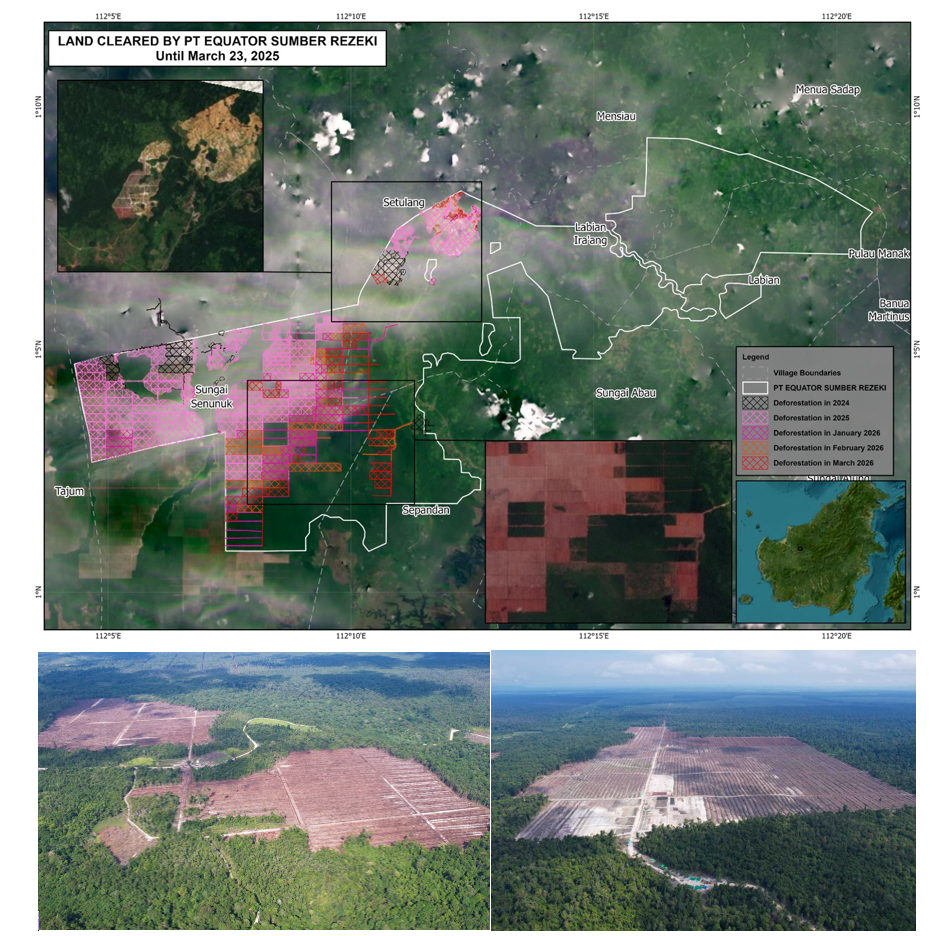
Satellite observations and photographs of extensive clearance of forest by First Borneo Group in the oil palm concession of PT Equator Sumer Rezeki, 2024-2026 (Mighty Earth 2026).
In addition, new threats are emerging. Nickel mining is a major driver of deforestation and social conflict in areas like Sulawesi, Halmahera and parts of Papua.
One such case is the Island of Kabaena off the coast of Sulawesi. This is a “small island” which, according to Indonesian law, means that mining activities should be prohibited. Despite this, 73% of its land area is covered by mining permits.
The island has a population of 40,000 people, including the Indigenous Moronene people who traditionally depend on small-scale farming and forest resources, and the coastal Indigenous Bajau people. The seas around the coast used to be a beautiful clear blue, but are now turbid with pollution. Fish stocks are declining and coral reefs are damaged. Long-term exposure to air and water pollution from mining increases the risk of cancer and cardiovascular diseases.
The round table discussion held by the APPG on Global Deforestation underlined the importance of UK government negotiations on critical minerals to integrate environmental and human rights safeguards into bilateral agreements.
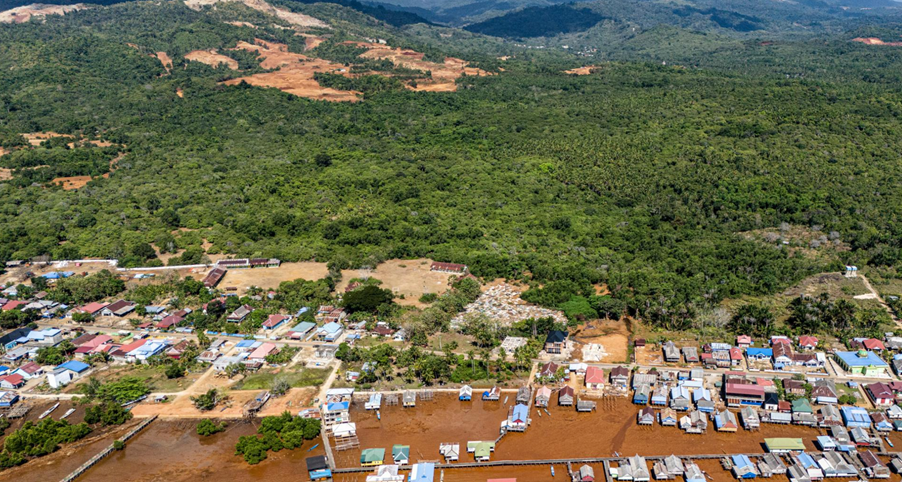
Aerial photograph of the coastal waters of Kabaena Island, Indonesia, where nickel mining has caused air and river pollution, with impacts on people’s health.
The roundtable discussion also highlighted the impact of a three-million-hectare Food and Energy Estate project, allocated for sugarcane and rice production to contribute to national food and energy security. This is classed as a National Strategic Project, and as such it overrides existing forest protections. It has been described as the “world’s largest deforestation project” by the Financial Times. As of December 2025, 43,800 hectares in total, or over half the area of New York City, have been cleared in the Merauke Food Estates for sugar and rice.
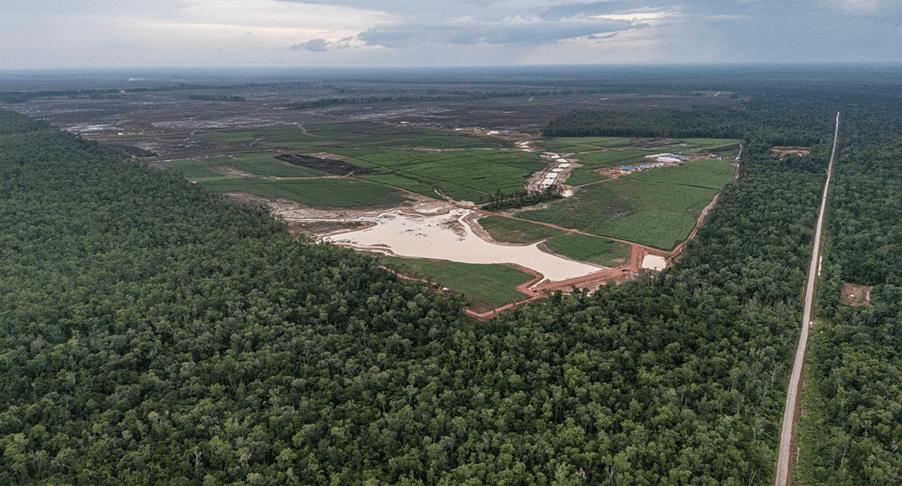
Photo of land clearance at PT Murni Nusantara Mandiri, Jagebob District, South Papua, 20 January 2026. Photo: Yusuf Wahil/Mighty Earth
The NGO Forest Coalition participants at the APPG event asked the UK government to raise concerns with the Government of Indonesia about human rights violations and displacement of Indigenous groups for the Food Estate project.
The positive impact of the UK’s support for forest governance was highlighted by members of the NGO Forest Coalition. The UK Timber Regulation and funding for international climate finance for Indonesia has led to significant improvements, including through development of Indonesia’s Timber Legality Assurance System (SVLK).
Looking ahead, meaningful civil society engagement and data transparency are essential to maintain the progress made towards ensuring legality and sustainability of Indonesian logging and timber exports. The UK government can support the Indonesian government to retain and strengthen the Timber Legality Assurance System and should advocate for a continued role for independent civil society monitors.
The discussion closed noting that the UK has worked successfully with Indonesia over recent decades to address deforestation and promote sustainable forest management to combat climate change. Indonesia remains an important partner for the UK in advancing shared global climate commitments, particularly forest protection.
The APPG on Global Deforestation’s immediate goal is for the UK government to implement forest risk commodity regulations, to end the import of palm oil and other commodities grown on illegally deforested land in Indonesia and around the world.

